
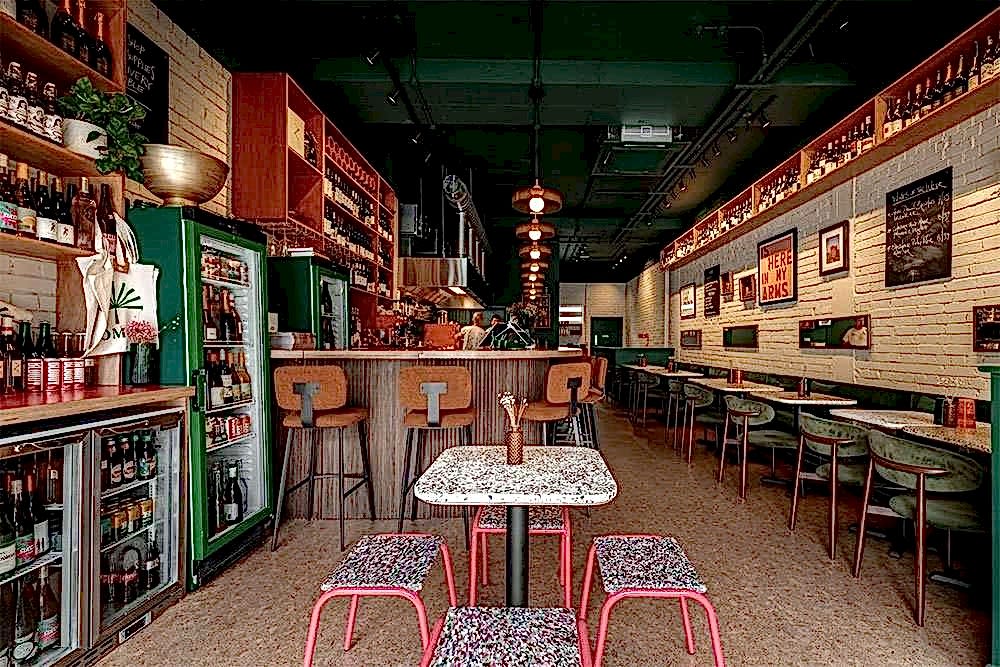
Cork flooring is having a quiet return to high-end hospitality interiors. After 30 years of being unfashionable, it’s now visible again in boutique hotel lobbies, restaurant bars, hospitality reading rooms and spa public spaces, in some cases as the visible biophilic statement, in others as a workhorse acoustic surface that disappears into a richer material palette.
This guide covers what cork actually delivers in hospitality contexts, where it earns its place over engineered wood or LVT, and the specification choices that determine whether the floor reaches the design intent or fails on year three. 2026 update: the Classic Cork Collection now includes a cork-composite waterproof core, dramatically expanding the hospitality applications cork can address, bathrooms, spa wet zones and food-and-beverage service routes are now in scope.

Why cork is back in hospitality
Three forces are driving the return. First, the biophilic design movement, cork delivers natural texture and warmth that no synthetic floor can match, in spaces where the brief is increasingly about creating environments guests want to spend time in rather than just move through. Second, sustainability scrutiny, hospitality operators are under increasing pressure to substantiate environmental claims, and cork delivers genuinely on embodied carbon, indoor air quality, FSC chain-of-custody and circularity in ways that vinyl and engineered wood don’t. Third, the acoustic problem, high-end hospitality interiors with hard surfaces and double-height lobbies need acoustic absorption that feels considered rather than imposed.
For specifiers working on hospitality projects in 2026, the question isn’t whether cork can deliver, it’s where in the project it earns its place and how to write the specification clause to protect the design intent through value engineering.
Where cork wins in hospitality
Public reception and lobby
The lobby is where cork’s biophilic and acoustic case lands hardest. Visible cork tile in 600x300mm or 900x300mm formats reads as warm, contemporary and considered against neutral palettes; the material has presence without dominating. The acoustic absorption (typically 14–19 dB ΔLw impact reduction depending on build-up) softens the reverberant problem of double-height lobby spaces, where the alternative is acoustic ceiling specification at significant embodied-carbon cost.
Specify ceramic-reinforced cork for lobbies (EN 685 Class 32–33 wear performance), with floating installation over an acoustic underlay tested to deliver the impact-sound target the project needs.
Bar, lounge and restaurant
Bar and lounge spaces benefit from cork’s warmth underfoot and from the airborne acoustic absorption that softens conversation and music spill. The 2026 Classic Cork Collection update introduces a cork-composite waterproof core, which means cork can now run continuously through bar fronts, lounge zones and spill-prone routes that previously required a material switch to vinyl. For continuous-submersion applications (specialist wet rooms, hydrotherapy plant), our Organic Collection, PVC-free bio-based polyurethane with R9 anti-slip, remains the right specification.
With the waterproof core, cork can now run from public dining and lounge through to bar fronts, washrooms and even hospitality kitchens (subject to slip-resistance specification on the surface finish). The mixed-material switch to Organic Collection is now reserved for hydrotherapy and continuously-immersed applications rather than every wet zone, coordinate colour and tone across both materials only where the project genuinely needs it.
Reading rooms, libraries and quiet zones
Cork is unmatched in hospitality reading rooms, library suites and quiet member spaces. The combination of impact-sound reduction and airborne acoustic absorption delivers an outcome that defines the room’s atmosphere, quieter, calmer, more inviting to lingering. The biophilic case is also strong: book-and-paper interiors benefit from natural floor finishes that complement rather than compete.
Specify polyurethane-finished cork in these spaces (durable enough for normal hospitality traffic, easier to recoat than ceramic-reinforced) in soft tonalities that complement the textile and timber palette of the wider scheme.
Spa, wellness and treatment circulation
Spa and wellness circulation routes (between treatment rooms, in changing-room dry zones, in member lounges) benefit from cork’s warmth underfoot, bare-feet circulation in spas reads colder on stone or vinyl than guests expect from a high-end wellness brand. Cork delivers the soft, warm underfoot experience without the cleaning-regime complications of textile flooring.
The 2026 update means cork can now run through spa public circulation, treatment-room dry zones, changing rooms and most spa wet circulation, the cork-composite waterproof core handles standard spa moisture exposure. Hydrotherapy pools, steam-room interiors and continuously-flooded floors still call for Organic Collection or a specialist wet-room resilient with the right slip rating, but the boundary has moved meaningfully.
Where cork doesn’t belong in hospitality
- Hotel guestroom corridors: impact sound reduction is the dominant brief, and acoustic vinyl or bio-based resilient delivers higher ΔLw values (typically 18–22 dB) than cork while tolerating the heavy castored-trolley traffic of housekeeping and room service. Cork in hotel corridors is the most common cork specification mistake we see.
- Hotel guestroom interiors: partly an acoustic question (carpet typically delivers better impact sound for the room above), partly a maintenance question (room turnover cleaning regimes don’t suit cork’s recoat cycle). Specify carpet or premium engineered wood in guestrooms.
- Continuous-submersion zones: hydrotherapy pools, steam rooms, permanently flooded floors. The cork-composite waterproof core handles standard wet-area moisture but not constant immersion. Use Organic Collection or specialist wet-room resilient for these applications.
- Heavy castored-traffic public floors without barrier protection, airport hospitality, large cafeteria spaces with rolling food trolleys.

The mixed-specification approach
The most considered hospitality specifications use cork and a wet-area-suitable bio-based resilient together, zoned by use. A boutique hotel project we worked on recently specified cork through public reception, the bar lounge, a meeting suite and the spa public circulation; bio-based resilient through guestroom corridors, back-of-house, the spa wet zones and food and beverage service routes. The floor finish brief reads as one continuous design language because the colour and tone work was coordinated across both materials, but the technical performance is matched to room-by-room demands.
This approach plays well with sustainability scoring too. The cork-specified zones drive the headline embodied carbon and biophilic narrative; the bio-based resilient zones don’t penalise it heavily because they’re smaller-area utility spaces, and choosing bio-based over conventional vinyl avoids the PVC question entirely.
For a deeper exploration of when each material wins, see our cork vs vinyl comparison.
Maintenance in hospitality use
Hospitality cleaning regimes are more aggressive than office regimes, daily wet mopping in public spaces, weekly deep clean, periodic stripping and resealing in high-traffic zones. Cork in hospitality use needs:
- Recoat every 5–7 years in public spaces (daily-traffic zones); every 8–10 years in lower-traffic zones
- Sand-and-refinish every 12–15 years, this is the cycle that resets the floor visually and extends service life into the 30+ year range
- pH-neutral cleaning products only, never alkaline strippers or acidic cleaners
- Spot repair protocol for damage, cork accepts local sand-and-recoat repair without obvious patch lines, unlike many lacquered surfaces
Build the recoat budget into the maintenance plan at design stage. The cumulative maintenance cost is meaningful but the trade-off is a floor that reaches end-of-life looking original rather than tired, an asset class advantage in luxury hospitality where guest-facing surfaces showing age erode brand premium.
Specification clause for hospitality cork
Floor finish (cork zones): cork tile, [manufacturer],
, [colour reference], 4mm thickness, ceramic-reinforced or polyurethane wear layer (EN 685 Class 32 minimum). FSC chain-of-custody (certificate ref [number]). EPD reference [number]. Indoor Air Comfort Gold or equivalent IEQ certification. Installation: floating system over acoustic underlay tested to ΔLw ≥ [value] dB (ISO 717-2). Cork zones limited to dry public spaces; bio-based resilient floor (per separate clause) in wet circulation, back-of-house and food service routes. Substitution permitted only with equivalent or better performance across all listed criteria, subject to specifier approval in writing.

Working with The Floor Gallery on hospitality cork specifications
Our cork range, Classic Cork Collection and Cork Styles, covers the heritage visible-grain cork suited to lobbies and reading rooms, and the printed and reinforced cork-carrier products for high-traffic hospitality circulation. We supply the matching Organic Collection bio-based resilient for the wet-area zones in mixed specifications, with colour and tone coordinated across both materials.
For project-specific specification support, including review of draft specifications, BREEAM credit calculation and CAD specification details for hospitality projects, contact our team via the architects’ page. Sample dispatch within 48 hours, international supply.
For broader cork specification reading, see our complete cork flooring guide for architects.